 The Green Fee
 If you missed Part 1, catch up on the history of Adams Golf here before diving in. Everything below builds directly on why this brand still matters.
The Problem: Modern Golf Lineups Are Too Confusing
Back when I was deep into my golf equipment obsession, brands split their lineups in a way that actually made sense. TaylorMade had the R-Series for better players running alongside RBZ or Jetspeed for recreational golfers. One had movable weights and tour-level tuning. The other had an adjustable hosel and not much else. Simple, clear, done.
PING did the same thing even more elegantly, with three distinct lines:
- I-Series for golfers who wanted a little help
- G-Series for the masses
- K-Series for max game improvement
Compare that to today. Browsing PING’s current iron lineup, you’re choosing between the i540, i240, G740, G440, Blueprint S, and Blueprint T, all doing something slightly different with almost no clarity on which one actually fits you. Drivers aren’t any easier. PING currently offers seven different driver models inside the G440 line alone.
And PING isn’t even the worst offender. Callaway currently lists 13 unique iron models on their website, seven of which fall under the Apex name alone. At some point, the average golfer walking into a store just gives up and buys whatever’s on the rack.
The Fix: Three Lineups, Three Players, Zero Confusion
For Adams, we’re going back to the old formula: three distinct lineups, each built for a specific type of golfer, with a few classic Adams names brought back for a hit of nostalgia.
Here’s the full breakdown.
1. Adams Idea Pro: The Better Player’s Lineup
This is the tour-level tier, classic shapes, elite feel, and serious performance. The Idea Pro lineup includes a driver, fairway woods, hybrids, and irons.
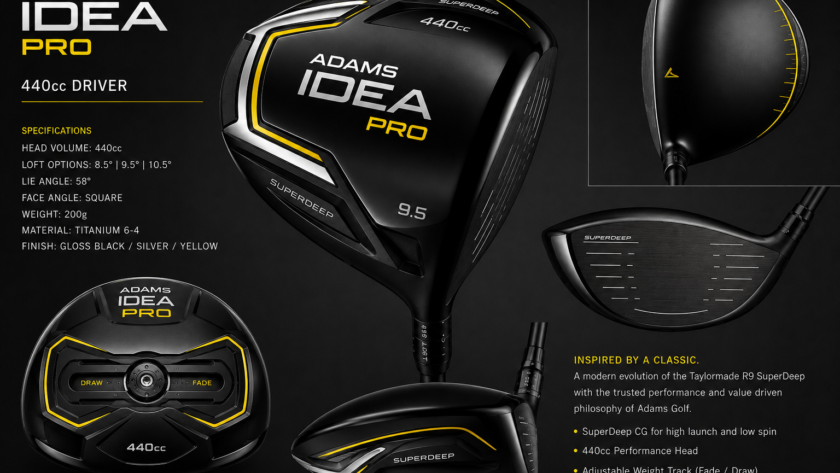
The Driver
- 440cc head with a deep face, inspired by the original TaylorMade R9’s super-deep profile
- Sliding weight track across the back of the head for adjustable draw/fade bias
- Hot-melt customization port built into the sole for fitters
- Carbon fiber construction to solve the “cheap, tinny sound” problem that plagues most off-brand drivers today
- Colorway: Black and silver with classic Adams yellow accents
The Fairway Woods
Inspired by the original Callaway X Hot 3Deep, these woods feature a deep face built to work off the tee and off the deck, unlike a mini driver that only shines from a tee. The adjustable hosel stays, but the profile is clean and understated. Once a player finds a great 3-wood, they tend to keep it for years, so this is a “set it and forget it” club by design.
The Hybrids
A near-direct homage to the original Adams Idea Pro Hybrid, the club that took the PGA Tour by storm in 2008. If the shape was good enough to dominate tour bags back then, it’s good enough to bring back now, with a few modern performance updates layered in.
The Irons
This is where things get interesting. A true players CB, similar in spirit to the Cleveland 588 CB from around 2012:
- Minimal offset (with a touch, since most modern players’ irons include some)
- Forged Construction
- True chrome finish, a nod to classic styling most brands have abandoned
- Clean cavity branding: just the Adams red triangle, nothing else
- Loft range: 21° (4-iron) through 46° (PW)
- Custom loft-gapping available at select fitters, so instead of standard 4-degree gaps across the whole set, a fitter could build in a 4° gap from 7 to 8-iron and a 3° gap from 4 to 5-iron based on actual distance needs
2. Adams Speedline: Built for Distance and Aspiration
The Speedline name has real history. The original Speedline lineup practically invented the “speed slot” now standard across the entire industry, and it racked up long-drive competition wins along the way. This tier includes a driver, fairway woods, a mini driver, and a full set of players-distance irons.
The Driver(s)
- 460cc head
- Matte gray crown with a royal blue sole, echoing older Speedline colorways
- Released in two versions: a standard model and an LS (low spin) model with forward weighting
Why two versions? Most low-spin drivers on the market automatically push players toward a fade bias, but not every golfer who needs lower spin also wants to fade the ball. This LS model sits dead center in the lineup: mid launch, mid spin, built for players who just need the spin numbers down.
The Fairway Woods
This is the technological showcase of the entire series:
- Titanium face, pushed as thin as engineering allows
- Matte gray carbon fiber crown
- Design priority, in order: ball speed, ball speed, ball speed
The Mini Driver
A genuine mini driver, but built the right way. Most mini drivers on the market today have gotten too big and too deep, making them clumsy off the deck. This one flips that formula:
- 3-wood length shaft
- 12° of loft
- Rear-weighted design built for real fairway use, not just a shrunken driver you occasionally hit off a tee
The goal here is a “jacked-up 3-wood,” not a mini driver in name only.
The Irons: Players Distance
This tier fills a gap that didn’t exist during Adams’ original run: the modern Players Distance Iron category. Perfect fit for a golfer who wants forgiveness and distance but still wants to like what he sees at address.
- Pitching wedge loft around 45°, with 4° gapping through the set
- Brushed steel finish (not chrome)
- Forged face, cast body
- Foam-infused cavity to tune sound and feel, addressing the harsh, hollow strike sound that hurt clubs like the original i500
- Speedline branding across the back, Adams “A” logo on the toe
- Loft and lie adjustable at fitting, though with less deep customization than the Idea Pro line
3. Adams Tight Lines: The Game Improvement Lineup
Named after one of Adams’ most consistent historical lineups, this tier is built for the golfer who plays a few rounds a year with friends and just wants reliable, good-looking equipment.
The Driver
- Significant offset and draw bias
- 9.5° stock loft, standard launch conditions, intentionally not built as a high-launch driver
- Why: many golfers in this category bring excess swing speed from other sports, or actively try to scoop the ball into the air and end up with weak, high-spinning pop-ups. Keeping loft and launch controlled avoids that trap entirely
- Less carbon fiber than the other two lineups
- Colorway: simple black head with red accents, a signature Adams color since the brand’s earliest days
The Fairway Woods
Higher-launching, softer-landing woods built with a shallow face to glide through rough and make contact easy from the fairway. These are designed to be usable immediately, no adjustment period required.
The Irons
The design brief here is simple: build something close to the PING G20, one of the best game-improvement iron sets ever made. It was never the prettiest iron on the shelf: plenty of offset, a chunky cavity, but it remains one of the easiest sets to hit ever produced. That’s exactly the target here.
What’s Missing: Putters and Wedges
You’ll notice this lineup skips putters and wedges entirely, and that’s intentional. The current market for both categories is already excellent and brutally competitive:
- Wedges: Vokey already dominates this space, and that’s before even mentioning Cleveland RTX, the Callaway Opus lineup, or the Taylormade MG series.
- Putters: This market is even tougher to break into. Even TaylorMade, with all its resources, struggled for years to land a true premium putter until the Spider became a genuine hit. Outside of that, Odyssey owns the value tier, and Wilson makes a surprisingly strong putter too. It’s a flooded, mature market, and Adams’ money is better spent elsewhere.
What’s Next
We now have a full three-tier product lineup: Idea Pro for better players, Speedline for distance-chasers, and Tight Linesfor game improvement. The next question is the one that actually determines whether any of this works: how do we market it?
That’s exactly where Part 3 picks up. Stick around.